Sunday, November 25, 2012

Beijing, The Great Wall


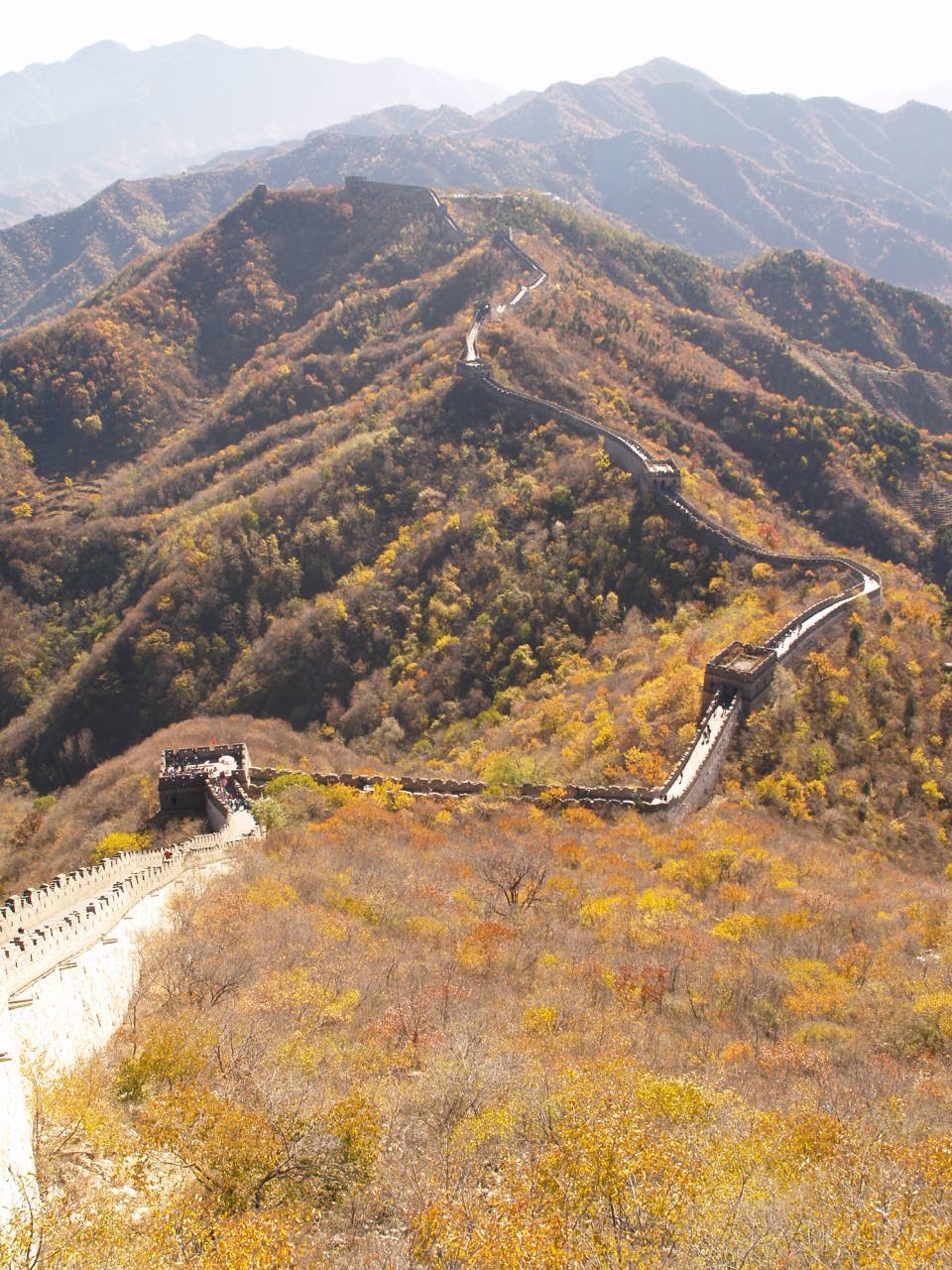
From Xian we took an evening flight to Beijing. We had arranged for a trip to the wall the next morning  It was one of those picture perfect days, the air was cool not cold and there wasn't a cloud in the sky, we had lucked out. We drove to Mutianyu one of the less crowded areas outside of Beijing to view the wall. Upon arrival we took a gondola ride from the valley floor to the ridge above. Mutianyu is consider one of the best-preserved parts of the Great wall. This section was first built in the mid-6th century and in 1569 was rebuilt. Using mostly granite, the construction is the best quality among all the sections of the Great Wall. The location was beautiful, with forests on both sides of the ridge. We took a long walk along the wall and then climbed stairs to the midpoint at an observation area. Stopping many times during our walk trying to take it all in, it was like being in the right place at the right time. I think I took over 200 pictures in a matter of several hours. Below is a small sampling of some of those shots. Like most pictures it does not really come close to telling the real store. This was truly a day to remember. 


the gondola lift

at the top of the lift a Chinese class posed for pictures

like most kids from other parts of the world, the boys being boys

first view of the wall

Margot

Margot has a history of taking jumping photos, I have pictures of her jumping all across the world

beautiful autumn day 

click on pic to enlarge


Linda, David, and Margot


stone plaque at the bottom of the gondola 

Wednesday, November 21, 2012

Xian part4 the terracotta hospital

Our tour guide Cathy walked us to the back of Pit 1. Here archaeologists painstakingly remove pieces and reassembly the soldiers. She calls this section the hospital. Below are several pictures of the process.

excavating a pit

sifting for pieces

putting the soldiers back together


the hospital staging area

tagged and ready

Sunday, November 18, 2012

Xian part3 the terra-cotta warriors


 Bing Ma Yong, the Terra-cotta Warriors, is one of China's most famous and popular tourist sites and one of the most sensational archeological discovers of the 20th century. Mr. Yang and three friends where digging a well in 1974 and came across an underground chamber of earth and timber that turned out to be one of the many concealed pits that contained the life-size warriors and horses made of terracotta.

Some say it is 8th wonder of the world. These terracotta figures date back to 210-209 BC and were made to protect the emperor in his afterlife. Emperor Qin came to the throne at the age of 13 and he started work on his mausoleum and armies soon after. He later became the first emperor of China.

 It took over 700,000 workers and 11 years to complete the project. Made in local workshops, studies show that eight face moulds were used and then clay was added for the individual facial features. After completion the figures were placed in the pits in precise military formation according to rank and duty. They were also brightly painted  and given real weapons of spears, swords, and crossbows creating a realistic appearance. The figures include 8000 soldiers, 130 chariots, 520 horses, 150 cavalry horses and an assortment of non-military figures including officials, acrobats, strongmen and musicians.

The Qin Terracotta Army Museum was set up to protect the artifacts and provide access to the area. There are 3 pits and massive buildings were constructed to cover the pits. Pit 1 is the largest, it is the size of over 2-1/2 football fields. It is divided into 11 corridors totaling 38 rows, estimated to house more than 6000 soldiers. Only a 1/3 of the pit has been excuvated uncovering 2000 warriors. Each pit was paved with bricks and originally had wooden ceilings supported by large beams and post. The ceiling were covered with mats and then mounded with soil 6 to 9 feet high.

One interesting fact is that all who were involved on the engineering and constructing of the tomb perished either by the terrible work conditions or were sacrificed or interred with the emperor to safeguard the secrets and the where-about of the tomb. 

Pit 1

officers lined up in front, rows of soldiers follow

Pit 1 with 3 rows of officers

all of these soldiers have been reconstructed from pieces found in the pit

in the background, this is how the soldiers were found after being buried for 2000 years 

close up, click on to enlarge
Pit 2 is 60 feet away and is just over the size of one football field, it is estimated to house over 1000 soldiers, 500 horse-drawn chariots and saddles horses.
very little has been unearthed

all of the corridors clasped over time 

archaeologist are waiting for improved technology before open these pits 
Pit 3 is 75 feet away from pit 2 is much smaller. In this pit was found one chariot, four horses and 68 warriors and based on the layout it was most likely the headquarters of the army. 

officers headquarters 
click on to enlarge


Wednesday, November 14, 2012

Xian part 2 the city wall


Xian City Wall is the best preserved city wall in all of China as well as the largest ancient military defensive systems in the world. The massive wall stands 40 feet tall, is 40+ feet wide at the top and over 50+ feet wide at the bottom. It is 8.5 miles around in length and includes a deep moat surrounding it. Every 360 feet is a rampart, 98 in total, which extends out from the main wall. There are only 4 gates one on each side in the middle of the wall and is the only way to get in and out of the inner city. In the 1980's the city built along the wall and moat, the City Wall Park, decorated with trees and flowers which adds additional beauty to the classical Chinese architecture of the wall.

One of the fun things to do is to rent bikes and bike around the wall, it takes 1-1/2 to 2 hours to make it around. It provides great views of the city. We rented bikes late in the afternoon and made it 1/3 of the way around the wall. The cobblestone riding surface in some areas became very bumping to ride on. 

Margot and Linda at gate with drawbridge 

ramparts 

wall with moat

David, Linda and Margot riding on the wall

gate 

Saturday, November 10, 2012

Xian part 1 The Han Yangling Mausoleum


In late October we visited Xian and Beijing. This was our first experience exploring China outside of Shanghai. Shanghai is very new, very modern, more modern then almost any city in the world. It is forward looking and has little interest in the past. Xian is rich in history and has focused on preserving and displaying this rich past. It has all the amenities of a modern city but maintains the feel of a historic Chinese city. Beijing is the home of the central government, it has grandiose buildings and the presence of the powerful communist government can be felt. The cityscape is more gray and most of the buildings look older, but I am told there is a vibrant edgy arts and music culture present there as well. 
Xian is one of the oldest cities in China with more than 3,100 years of history, it has over 8 million people and was recently named one of the 13 emerging megacities in China.  Xian lies in central China on a large flood plain created by the eight surrounding rivers that flow through it. It is now an important cultural, industrial and educational center and home to China's space exploration program.  Xian is one of the "Four Great Ancient Capitals of China", serving as the capital for several of the most important dynasties in Chinese history.  One of these was the Han Dynasty.

The Han Dynasty dates from 206BC to 220AD. It was customary  for the rulers during this time and throughout most of the dynasty's in China to prepare for your life after death. As soon as these Emperors and Empresses came into power they would begin work on their tombs. The idea was "to attend to the dead as if to attend to the living". In other words everything you had while living on earth you would have in your afterlife.

The Emperor and Empress were buried with their valuables in large tombs and in burial pits surrounding the tomb were buried  representations of everything they needed for the next life. In the Han Yangling Mausoleum 81 burial pits were discovered surrounding the Emperors tomb. Clay figures a 1/10 the scale of humans that represented various soldiers, bureaucrats, and servants were discovered in these bits. Only 14 of these pits have been partially excavated and over 3000 items have been found. The Chinese have stopped all excavation currently and are waiting for technology to better preserve their  findings. It was discovered early on that as soon as the items were unearthed the vibrantly painted relics would oxidize in a matter of days and the color would disappear.

Each pit vividly detailed what life of the royal families and the ordinary people were like in the Han Dynasty. Clay warriors, chariots, horses, weapons, pottery, a large number of farm animals, servants, singers, or dancers and the list goes on and on where found. Each lifelike figure was painted and clothed, and was positioned on a tile floor. The pit was framed with wood walls and beams, covered with a mat and buried. Many of the pits where looted by tomb robbers and/or collapsed over the past 2000 years. 

A large exhibition hall was constructed over the opened pits where visitors can now watch how the workers do their jobs in unearthing these relics from above, standing on large glass floors. It is a very up close and personal experience. 

each pit had a theme, this was a kitchen pit

piglets with horse in the foreground

very large pits containing farm animals 

soldiers partially  uncovered 

each character had wooden arms and was dressed in an outfit

view from then glass floor

an example of how the pits where set up and buried 

Saturday, November 3, 2012

Update on Blog and Family


I would like to thank all of those who are reading my blog. Total pageviews since the 1st of July topped  700+ this week or roughly 175 a month. I have no idea who is reading it but I appreciate it. The number of readers have been increasing every month so hopefully you are returning to hear and see the latest in our travels and adventures. Please let me know if you have any questions or are interested in any topics about life in Shanghai. Email me at bmeweber@gmail.com.

I have been trying to average 6 to 8 posts per month. I must have at least 12 topics in the queue to post, it is just a matter of doing some research and reviewing all of my pictures.

It seems like the Weber/Clarke families are traveling to the Asia Pacific area recently. ME's brother Jimmy, his younger daughter Carly, recently moved to Singapore with her husband and 2 year old daughter for a two year stay with J&J. Robin's son Beau who is doing his NBA at U. North Carolina has been studying International Business in Beijing for the past year and is now fluent in Mandarin.  After 5 years in NYC our daughter Margot pulled up roots and moved to Shanghai for a few months or maybe longer to explore job opportunities. Our daughter Meredith has been studying at the University of Sydney for her junior semester abroad. On the Weber side, my cousin Richard's son Rich, besides getting married in December, is moving to Bangkok, Thailand in January to head up a biodegradable plastics company for about 3 years. And we had our first house quests this month, my sister Linda and her husband David, they are staying with us for 3 weeks. It's funny; in just a short time how one family can have this much exposure to the what is happening on the other side of the world. 

Rich, Margot, David, Linda, Bob, and ME 

Linda, Margot, ME, and David at Kafers Igloo Vodka Ice Bar
also see August 5 post

David and Linda at Yu Yuan Gardens

Sunday, October 28, 2012

Yu Yaun Garden


Yaun meaning garden is a pleasant Chinese garden in the heart of "Old Town" Shanghai.  Considered the loveliest of its kind, it is the most complete classical garden in urban Shanghai. It is also the must-see for every tourist, making it a nightmare to visit. The garden overflows daily with hordes of visitors and is no longer the pastoral haven it once was. Completed in 1577 as a private estate it is a maze of Ming Dynasty pavilions, arched bridges and goldfish ponds, surround by a dragon wall.

You entry and exit the garden through the Old Town Bazaar which is chock-full of large and small stores selling all kinds of souvenirs and food. Even though the area has become a tourist trap an early morning visit to the garden is well worth the time.

gold fish pond

Ming Dynasty pavilion

tree lined path

dragon wall used to divide the gardens

water way with arched bridge

bazaar outside of garden

pavilion with rockeries

zoom in

zoom in of roof

zigzag bridge

stage with porcelain instruments