Wednesday, July 10, 2013

Xeixie and Zai jian

Xeixie (pronounced "she she") in Chinese means, thank you. I would like to thank all of you for reading my blog. I recently reached 3000+ page views from posting over the past 11 months, with May having 304 page views. It has been a lot of fun taking pictures and writing about our year in Shanghai. 

Zai jian (pronounced "szī gē an") in Chinese means , goodbye. ME and I are packing up and will be saying goodbye to Shanghai. We will be returning home mid July. I will most likely do another 4 or 5 posts till the end of July.     


Thanks, and keep clicking on the link, Bob.
how we feel about Shanghai

night view of Pudong financial area with full moon 

Saturday, July 6, 2013

Longji Rice Terraces part 1

The Longji Rice Terraces is the most beautiful place we have been to in China. Located 2 hours drive north of Guilin in a vast forest mountainous area. Built over 700 years ago by the Zhuang and Yao minorities who larboard for several hundred years to create terraced rice fields that run up and down the mountainside. Small villages are scattered in the high valleys where the folks work 100 days out of the year to grow rice for their own consumption. To my surprise none of it is sold outside the area.

Longji means 'Dragon Backed Mountain", when the fields are flooded with water in the spring it is said that the terraces resembles the scales on the back of a dragon. In early spring the rice fields are prepped, then flooded by the natural springs at the tops of the mountains and then the rice is individual planted. We arrived just after the planting. The fields will be flooded for most of the summer and then drained. As the rice dries, the terraces turn an amazing yellow and then harvested in the fall.

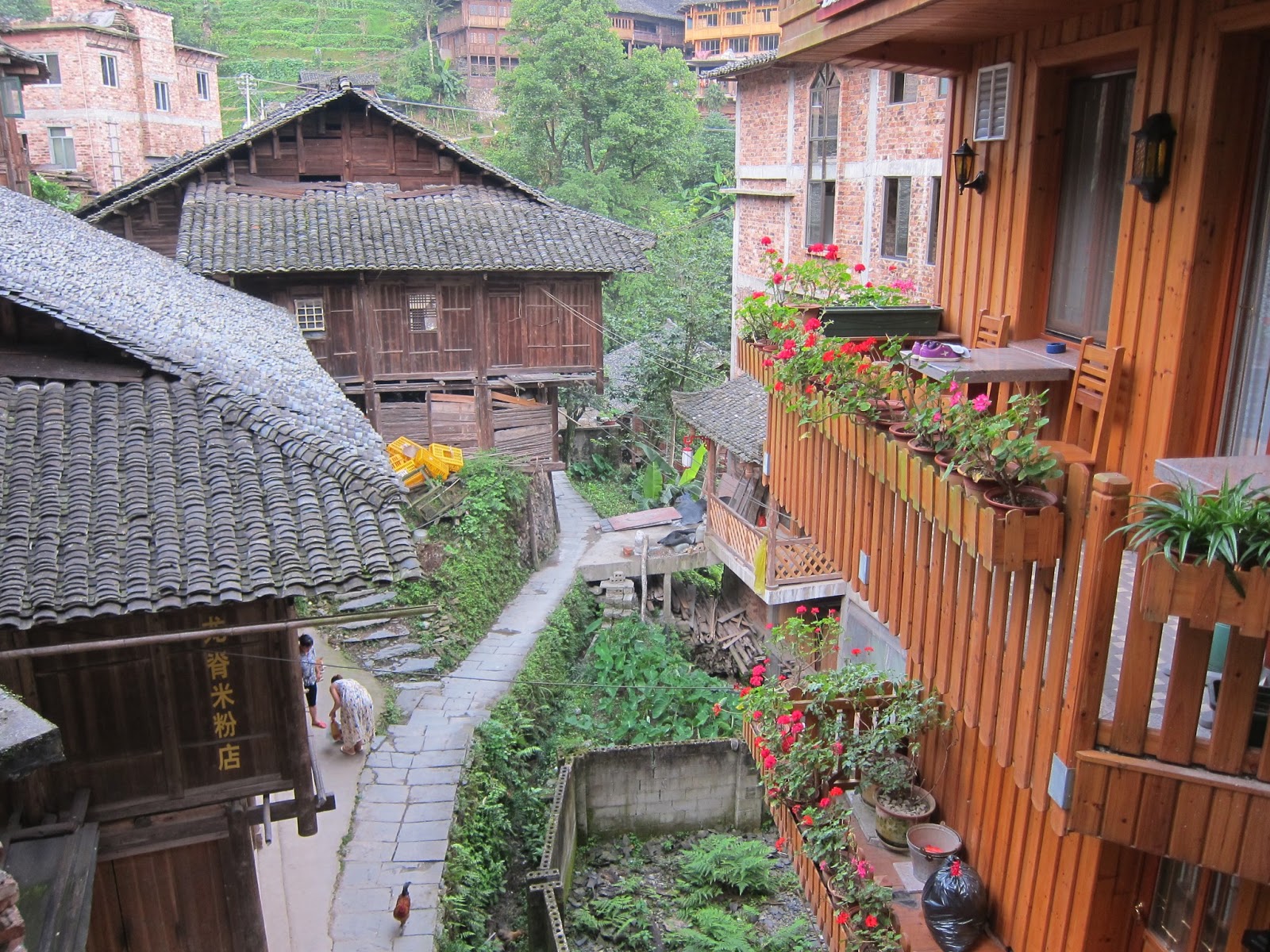
We arrived late in the afternoon at the parking lot below Ping'an the first and largest (700 people) of the three villages we were going to visit. There is no car/truck access to these villages. From the parking lot we had a 30 minute walk to our hotel which was in the center of the village. Everything in the village are either brought in and out by foot, by the Zhuang minority who live in this village or by small horses, everything!  To help earn money the villagers transport your luggage to your hotel. They carry several pieces of luggage in a woven basket much like a back pack. We walked along a stone path along the hillside and then entered the village where we wound our way up and around the unique homes nested in the hillside. We twisted and turned on narrow stone paths as we ascended our way up through the village. Besides the wonderful panorama views of the rice terraces we also got a good glimpse of the rural life and the architecture style of the minorities people found in these forest-fringed villages. We had a wonderful dinner on the deck of this restaurant in the middle of the village with a wonderful view of the rice terraces and the valley below.


The next morning we meet our guide and started our walk. Our backpacks where taken down to the parking lot where they were transferred to the next hotel in Dazhai where we were staying that night. We went on a 1-1/2 hour walk around Ping'an to two different viewpoints with spectacular views of the town and the surrounding terraces. 

walking up to the village

the women carrying our luggage and our guide

woman we meet along the way with woven backpacks

the village

stone walk ways in the village
click on to enlarge
in the center of the village

local elderly woman


small horses carrying construction material

another view of the village

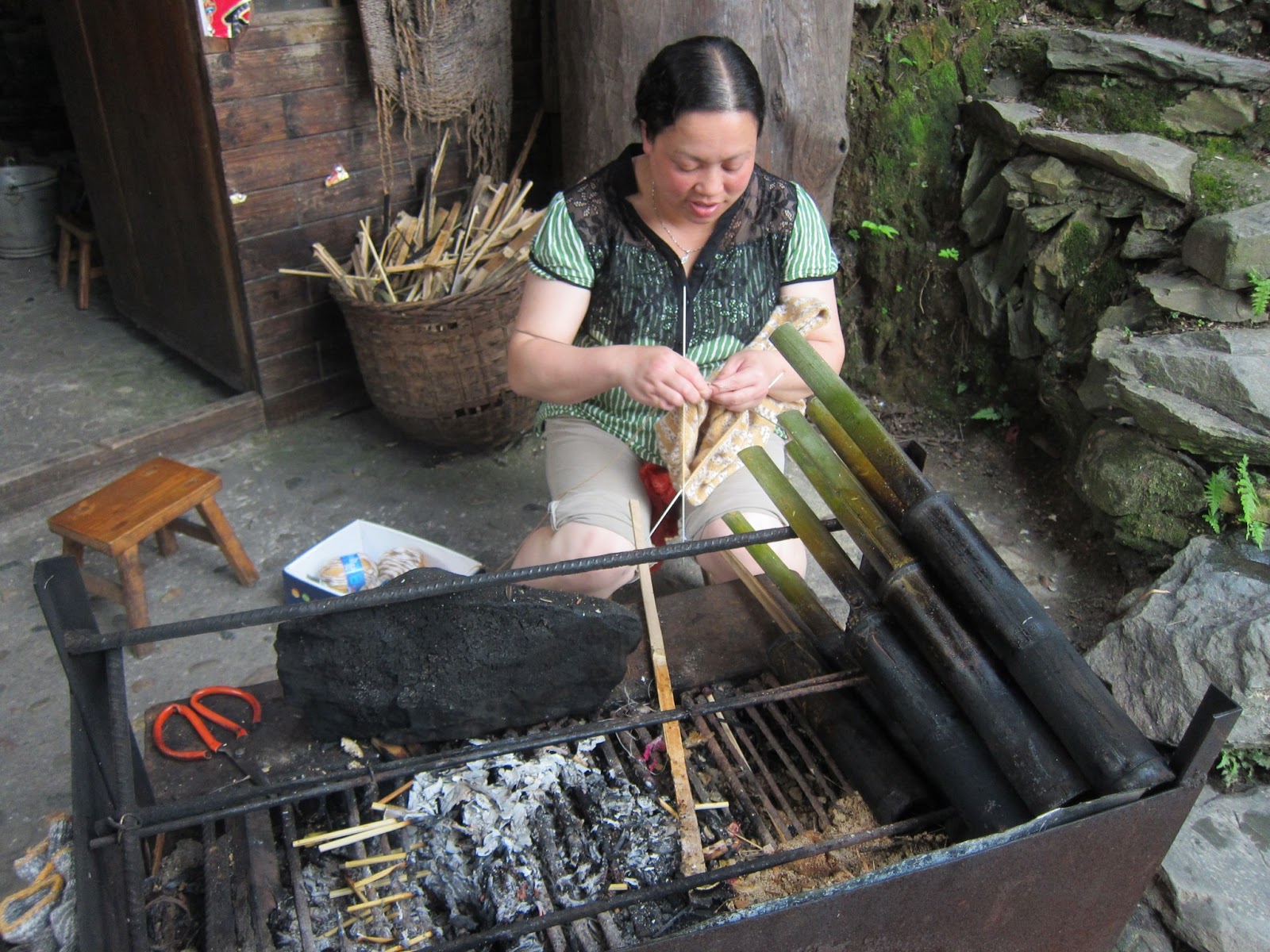
the local dish is grilled bamboo rice
here the bamboo is shaped to be stuffed 

being grilled

it is then split opened and served
a combination of sticky rice, pumpkin, corn and ham
all locally grown

view from our hotel window and the valley below

man tending the rice terraces

view of Ping'an and the rice terraces 

view of rice terraces surrounding Ping'an

stone path through the terraces 


looking down with path through the middle 

another view of Ping'an village

more rice terraces
I took over 500 pictures on this trip, the views were spectacular 


Saturday, June 29, 2013

the driver, the OP, and the ayi

We are very lucky and now that a we have been living in Shanghai for a year, we are now very spoiled! We have had the help of three people, who have made our stay in Shanghai very enjoyable.

 The driver, being an expat in Shanghai we have had the luxury of having a full time driver, Mr. Wang. Almost all expats and many of the Chinese have drivers too. I think with the prices of cars, (very expenses) the cost of getting a license plate for the car (now over $20,000) and the affordability of people, it almost makes more sense to lease a car with a driver. Plus once you see how people drive in China it makes even more sense. 

Dow like most international companies, hires a driver for each expat employee/ family living in Shanghai. His primary responsibility is to drive ME to work and back. When he is not driving ME around we can also use him to take us around Shanghai. In the evenings and on the weekends he is also available to take us to the many restaurants and night spots in the city. It makes going out at night very easy.

The OP or office professional, Lucia, is a Dow employee, who speaks very good English. She is assigned to ME as her secretary and to help family members while living in Shanghai navigate our stay when interacting with the Chinese.  For example she would help us with purchasing phones or topping them up when we run out of money or when we have issues with our apartment we would ask her to help translate with the apartment engineer or the maintenance people or help with misc travel arrangements etc. It gives you the satisfaction that if you get stuck anywhere help is only a phone call away.


The Ayi or "auntie" in Chinese (pronounced ī  ē) is a maid that many expats and Chinese have. Some are full time, especially families of young moms with kids, and some are part time, who do just about everything from minding the babies and young kids, to doing the cleaning, ironing, cooking, grocery shopping, to running errands. Most apartments have a very little room off the kitchen where a live-in ayi would stay. We hired a part time ayi, Jean, to clean, iron, and do some washing, she comes two days a week for four hours each day. We pay her 120RMB for the four hours ($19.50 or $4.90 an hour). She is a very nice lady who is always on time and does a wonderful job. Below are some pictures of the folks who have made are stay in Shanghai so enjoyable. 


our Buick 7 passenger van

Mr Wang with ME and Meredith

Elaine and ME, one of her OP's

ME, Mr Wang, Lucia the new OP, Elaine the old OP, and Margot

Jean our ayi 

one of my views while being driven around Shanghai

Monday, June 24, 2013

Guilin part 4 Yangshuo

After visiting the market in Xingping we drove further down the Li river to the town of Yangshuo. It is a very scenic small town, very popular with backpackers and tourist. The area around Yangshuo is renowned throughout China for its karst landscape. There are hundreds upon hundreds of limestone hills dotting the countryside. Many people go either cycling or on a river cruise on the Yulong River or a combination of both to check out the scenery. Our guide arranged for us to rent bikes from our hotel where we took a ride out of town along the river. We then took a leisurely bamboo raft ride (on real bamboo raft) for the next 2 hours including going over 5 little water falls along way. Upon going over the first waterfall photographers on floating docks  were waiting to capture your experience/expression. The man steering our raft stopped at the floating  dock, where we got out and reviewed pictures on a flat screen monitor. We picked 2 pictures and within minutes we had a 6x8 plastic coated picture.  Farther down the river there were more floating docks serving grilled fish and beer. People would stop and get off the raft for lunch or a afternoon drink.

Our bikes were shuttled down to the exit point of the rafting trip and from there we cycled 20 minutes to Noon Hill another of these must see places. It is billed as a unique formation where you climb up 700 steps to a lookout point with a big hole in the hill. At the trail head we meet two ladies carrying small coolers, selling cold water and soft drinks. The path was wet and in some parts slippery because of the earlier rain storm. I am not sure why, but the two ladies walked up the hill with us. One walked with ME and the other walked with me. We said several times that it was not necessary but they insisted. Both spoke some English enough to have a basic conversation. At the top we took pictures and hung out for about 20 minutes, then started our walk down. The one women literary helped ME all the way down, in some of the more slippery sections holding her hand. Once at the bottom ME made me buy a water from each one even though I was already carrying two water bottles.


We had another 1-1/2 hour bike ride to back to the hotel. Instead of using the main road back our guide took us along some back country roads and walkways. This was probably one of the most interesting and scenic parts of the day. We got a chance to see rural China and enjoy the incredible countryside. Below are pictures of the days experiences. 

starting point for the bamboo raft ride

going over water fall, with floating photo docks in background

taking pictures 

monitor, printers and plastic sealer on floating dock

one of the pictures we bought,
we were told to lift up our shoes when going over the waterfalls so they would not get wet

river view

a shower along the way

floating dock restaurants ahead 

returning the rafts to the starting point

Moon Hill

view from Moon Hill

helping ME over a slippery patch

our new friends

our guide, biking on the back roads

rice paddy 

typical 3 wheel truck with exposed tractor motor

our hotel in Yangshuo


Wednesday, June 19, 2013

Guilin part 3 Xingping market day

The next morning we went to the Xingping market. Any day of the month that ends with a 3, 6, or 9 is a market day in Xingping. It is a very active market and the town becomes very busy in the mornings, folks from many of the smaller neighboring villages come in by boat, bus, or trucks to buy and sell their products or produce.  There are also many services offered at the market. Below are some pictures of old town Xingping and the market.

on the ferry going to the morning market with the locals

men on the ferry

docks at Xingping village

women carrying goods to sell at the market

entering old town

street in old town

ME look to dogs for sale at the market

chickens for sale

an isle of chickens 

man using hand scale to weigh produce

the women in pink practices Traditional Chinese Medicine,
the folks are gathered around  going through a treatment, many have needles somewhere on there bodies

cupping a 3000 year old practice 

acupuncture on the knees of this lady

men selling herbal medicine, all plant based
used for over 5000 years, is the bases to Traditional Chinese Medicine 

a row of barbers in the market giving haircuts 

men selling tobacco, from leaves to ground up ready to use 

men eating hot pot, a very popular meal in China

men sitting around having soup also very popular